

Pumwani Maternity Hospital
Reducing waiting time for caesarean section deliveries
23 hours to 4.4 hoursaverage wait
In 2025, fourteen senior leaders from seven Kenyan hospitals became ACQUIRE’s first C-Suite Experiential Leadership cohort. For sixteen weeks they learned alongside the quality improvement teams from their own hospitals, and the teams delivered.
By 2025 ACQUIRE had trained hundreds of frontline health workers in quality improvement. The missing piece was the room at the top.
Teams were testing changes on the ward, but protected time, data, budget and the authority to make a change standard all sit with hospital leadership. So alongside the 2025 Experiential teams and coaches, ACQUIRE invited each hospital’s CEO and one other senior leader of their choosing into a learning journey of their own.
The executives worked on clinical governance and QI leadership, and each hospital took on a capstone tied to a real quality or patient-safety challenge.
Quality improvement and patient safety can’t rest on frontline teams alone. They need hospital leaders who actively lead, not just approve and monitor.Mary Adam, ACQUIRE, reflecting on the 2025 cohort
Each hospital sent its CEO and one senior colleague. Every one of them also had a frontline team in the 2025 Experiential cohort.
The cohort met early on Wednesday mornings on Zoom, before the working day began, and came together in person once.
The leaders met online for the first time. Each shared why quality improvement mattered to them, heard ACQUIRE’s purpose, and was introduced to the capstone and the A3 problem-solving template.
Live sessions on Zoom with guest speakers, each tested against the leaders’ own experience of running hospitals, plus reflections shared in the cohort’s WhatsApp group.
A residential workshop on leadership, reflective practice and co-production with patients. Each hospital presented its capstone up to an annotated run chart.
The hospitals’ frontline teams presented their results at graduation and at the ACQUIRE QI Leadership Forum on 10 to 11 July in Nairobi.
A closing session looked back on the year and ahead to 2026, and the leaders received their certificates.
The residential was the one time the cohort met face to face. Participants valued the content, and most said it was too short. Everyone loved the location.
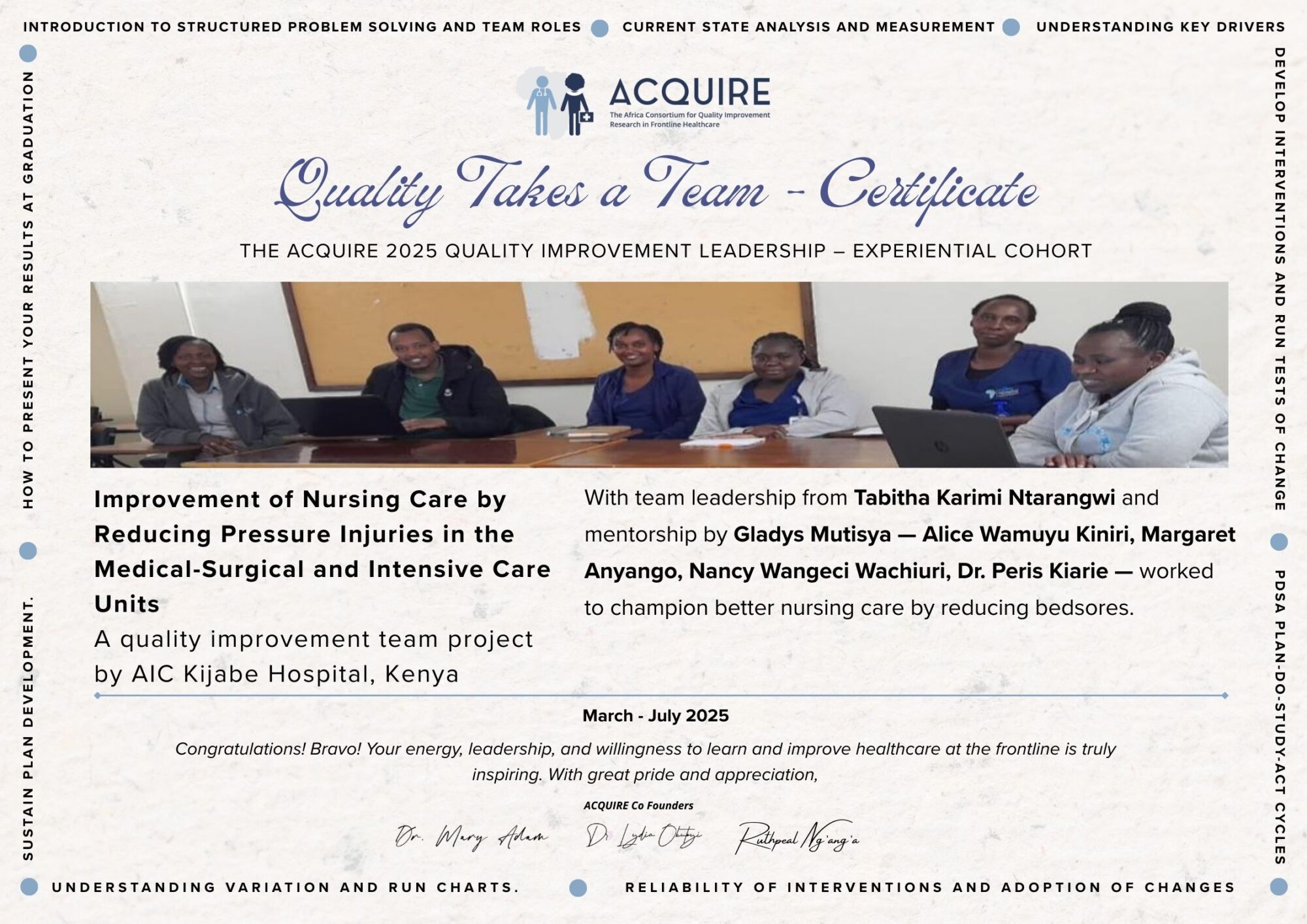
With their leaders in the room, every pilot hospital’s frontline team carried its project through to graduation in July 2025. These are the results they presented.
Results as presented by the teams at graduation. Every project is in the Learning Library.
The programme was co-produced: the leaders shaped the topics and fed back through polls, WhatsApp and peer discussion. Here is what the first cohort taught ACQUIRE.
Leaders helped decide what they learned, which kept the sessions close to the problems they were actually facing.
Early small-group conversations built the psychological safety that let executives speak openly about their hospitals.
Learning between public, private and faith-based hospitals was among the most valued parts of the course.
Some executive teams still handed ownership of the capstone to technical staff rather than holding it themselves.
Backing a team did not automatically turn into protected time for QI work on the ward.
Turning engaged leaders into lasting institutional change remains a work in progress, and the reason the course keeps evolving.
The pilot changed how ACQUIRE works with hospitals. Senior leaders are now part of every frontline team’s journey.
Every Experiential Cohort One team in 2026 named senior leaders to sponsor its work.
Explore the Learning Library 2027A five-week course for CEOs and senior teams, built on what the pilot taught us.
See the course 451See every hospital’s full ACQUIRE story, from theory learners to senior leaders.
Browse institutionsPress Enter to search · Esc to close